Robotics in Agriculture: Are Farms Becoming Robot Territory?
From autonomous tractors to robotic harvesters, agriculture is becoming one of the most robot-heavy industries on Earth. We break down what counts as a robot on the modern farm.
Robot Conundrum
7/6/2025
Robots Working the Fields and Gathering Crops
When people imagine robots, they tend to picture factories, warehouses, or sci-fi cities. What they rarely picture is a farm.
And yet, modern agriculture is quietly becoming one of the most robot-dense environments in the world. Machines plant seeds with centimeter precision, drones survey crops from the air, and autonomous vehicles drive themselves across thousands of acres without a human in sight.
This raises an important question: are these just smarter machines, or has farming genuinely entered the age of robotics?
To answer that, we need to look at what agricultural robots actually do, and whether they meet the basic requirements of being a robot at all.
What Makes a Farm Machine a Robot?
As always, we'll use the Sense–Think–Act framework.
- Sense: Does the machine perceive its environment?
- Think: Does it make decisions based on that data?
- Act: Does it physically interact with the world?
Traditional farm equipment handles the “act” part very well. What's new is how much sensing and thinking is happening onboard.
The Case For Agricultural Robots
Autonomous Tractors
Modern tractors are no longer just engines with wheels.
- GPS systems track position to within inches
- Cameras and lidar detect obstacles
- Onboard computers adjust speed, direction, and tool depth
An autonomous tractor senses its surroundings, plans routes, and executes tasks without constant human control. That is textbook robot behavior.
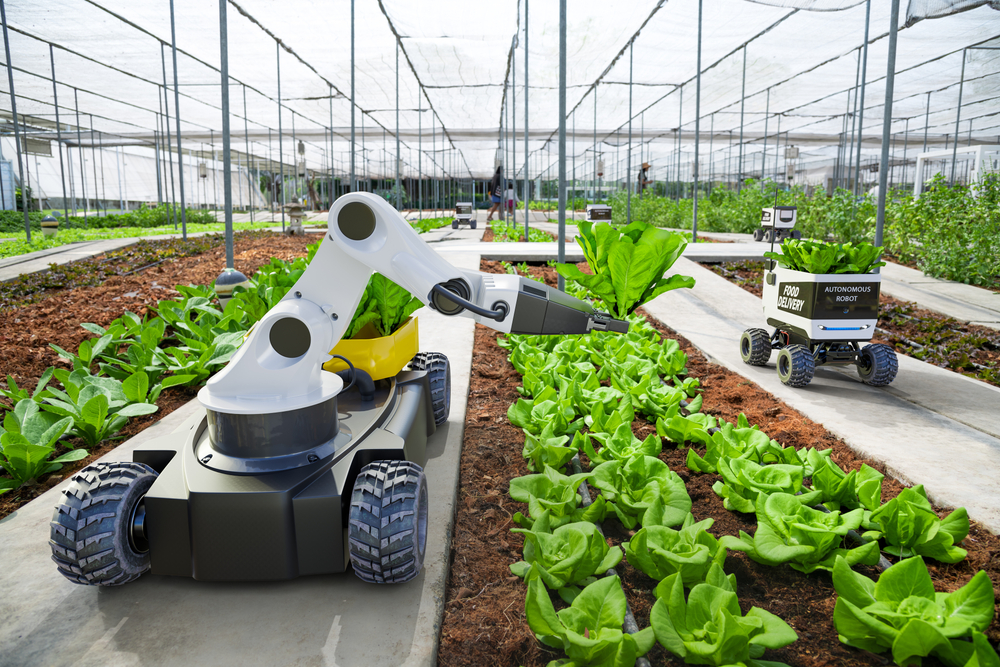
Robotic Harvesters
Harvesting is one of the hardest tasks to automate. Crops vary in size, ripeness, and position.
Robotic harvesters use:
- Vision systems to identify ripe produce
- Algorithms to determine grasp points
- Mechanical arms to pick without damaging crops
This is not simple automation. These machines adapt to variation, which is one of the strongest indicators of robotics.
Drones and Aerial Robots
Agricultural drones monitor crops from above.
- They sense plant health using multispectral cameras
- They analyze stress, pests, and irrigation needs
- Some can spray targeted treatments
When a drone decides where to fly, what to inspect, and when to act, it qualifies as a robot, not just a remote-controlled tool.
The Case Against: Are These Just Smart Machines?
Limited Autonomy
Many agricultural systems still rely heavily on human oversight.
- Routes are preplanned
- Tasks are narrowly defined
- Humans handle exceptions and failures
In these cases, the machine is executing instructions rather than pursuing independent goals.
Task-Specific Intelligence
Farm robots are extremely specialized.
A harvesting robot cannot suddenly switch to repairing fences or feeding livestock. Its intelligence is narrow and purpose-built.
That doesn't disqualify it as a robot, but it does limit how “robotic” it feels compared to more general-purpose systems.
The Gray Area: Between Automation and Robotics
Agriculture sits right on the boundary between automation and robotics.
Many systems:
- Sense extensively
- Think just enough to optimize tasks
- Act repeatedly in controlled environments
They don't reason abstractly or improvise like humans, but they don't need to. Farming rewards consistency, precision, and endurance more than creativity.
In that sense, agriculture is a perfect environment for robots to thrive.
The Verdict
So does robotics truly belong on the farm?
- Traditional tractors: Machines
- GPS-guided equipment: Automated machines
- Autonomous tractors, harvesters, and drones: Robots
When a system senses the field, decides how to respond, and physically acts without continuous human control, it crosses into robot territory.
Conclusion
Robotics in agriculture isn't about replacing farmers. It's about extending what they can manage.
As farms grow larger and labor becomes scarcer, robots offer consistency, precision, and the ability to operate day and night. They may not look like humanoids, but they are quietly redefining what a robot looks like in the real world.
If you want to know where robots are actually succeeding today, don't look to science fiction. Look to the fields.