Is a Dishwasher a Robot? A Serious Case For and Against
Is a dishwasher just a machine, or does it cross the line into robot territory? We analyze dishwashers using the Sense–Think–Act framework and make the case for and against calling them robots.
Robot Conundrum
5/3/2025
The Most Unassuming Robot Candidate in Your Kitchen
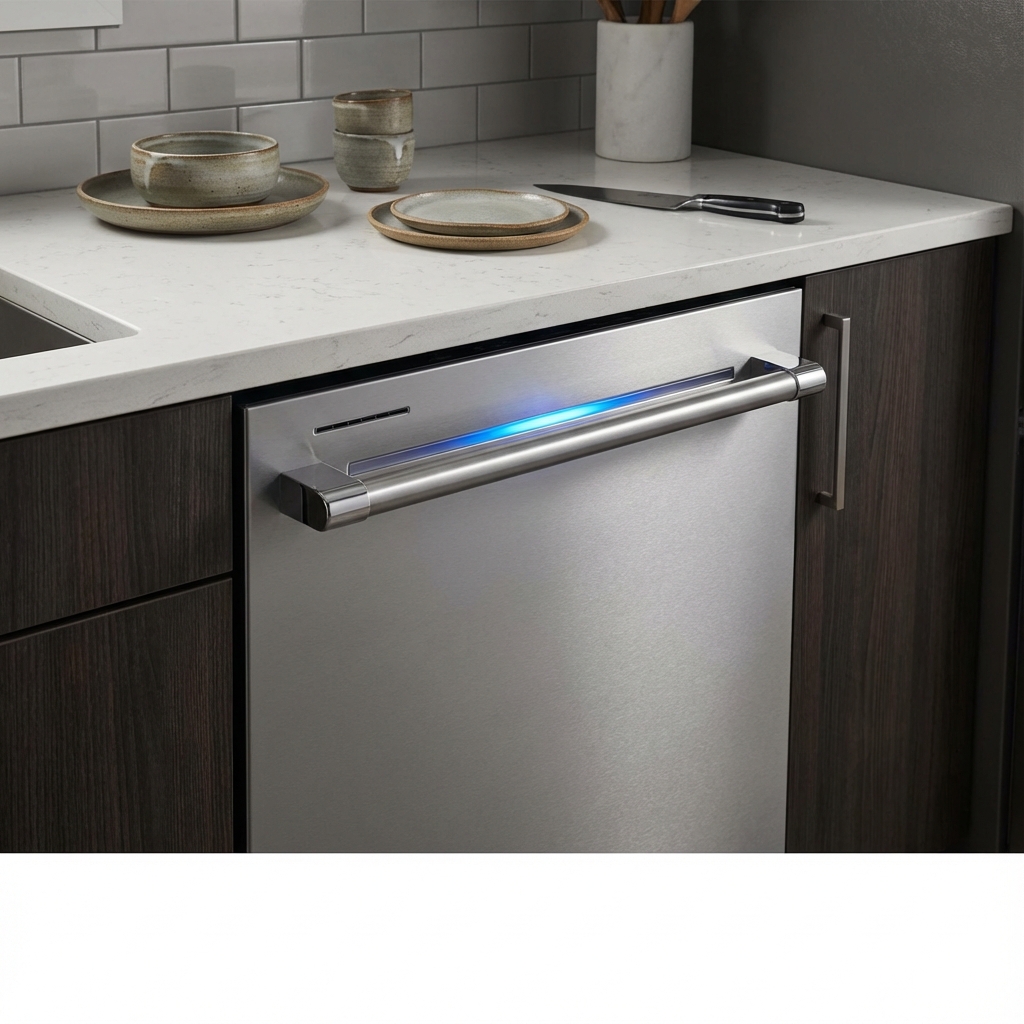
A dishwasher doesn't look like a robot. It doesn't roll around your house. It doesn't talk back. It doesn't even try to pretend it has a personality. It sits quietly under your counter and does exactly one job: clean dishes.
And yet, modern dishwashers sense their environment, make decisions, and change their behavior based on what they detect. Some adjust cycle length automatically. Some detect how dirty your plates are. Some decide how much water and energy to use without asking you.
So here's the uncomfortable question: at what point does a machine that makes decisions stop being “just a machine”? Is a dishwasher still a dumb appliance, or is it quietly crossing into robot territory? Let's try to determine that using the Sense–Think–Act cycle.
The Case For Calling a Dishwasher a Robot
Sense: Dishwashers Are Not Blind
Modern dishwashers are packed with sensors, even if you never see them.
- Turbidity sensors measure how dirty the water is.
- Temperature sensors monitor water heat.
- Water level sensors track how much water is in the tub.
- Door sensors know if the machine is open or closed.
This means your dishwasher isn't just following a timer. It's actively sensing what's happening inside during the wash.
Think: Some Dishwashers Make Real Decisions
This is where things get interesting.
Many modern dishwashers use sensor data to decide:
- How long the wash cycle should run
- Whether an extra rinse is needed
- How aggressively to spray water
- When to switch from washing to drying
If the water is still dirty, the dishwasher keeps washing. If the water clears up quickly, it may shorten the cycle. That's conditional logic based on sensor input. In other words, it's thinking in a very limited but real way.
Act: It Physically Changes the World
Dishwashers clearly pass the “act” test.
They open and close valves, spin spray arms, heat water, drain waste, and dry dishes. These actions are not random. They're triggered by internal decisions made during the cycle.
Put together, many modern dishwashers do complete the Sense–Think–Act loop autonomously once you press “Start.”
The Case Against Calling a Dishwasher a Robot
No Goal Beyond What You Gave It
A dishwasher has no independent goal. It doesn't decide to clean dishes. You decide that for it.
Once started, it cannot:
- Choose not to run
- Change its objective
- Adapt beyond a narrow range of predefined behaviors
Its “decisions” are bounded tightly by what engineers anticipated years ago.
No Awareness of the Outside World
A dishwasher's sensors only perceive its own internal environment. It doesn't know:
- What kind of dishes are inside
- Whether the plates are fragile or expensive
- Why the dishes are dirty
It reacts to water clarity and temperature, not meaning or context. This makes it very different from robots that navigate open environments or interact with humans.
It Cannot Learn or Improve
Most dishwashers don't learn from past runs. They don't remember that yesterday's load was heavy or that you always run them overnight. Each cycle starts fresh, executing predefined logic.
Without learning, adaptation is shallow and strictly mechanical.
The Gray Area: Smart Appliance or Primitive Robot?
This is where dishwashers live comfortably: the gray zone.
They are far more than passive machines. Old dishwashers from decades ago ran on timers alone. Today's models monitor conditions in real time and adjust behavior accordingly.
But they fall short of what most people intuitively mean by “robot” because:
- Their environment is closed and controlled
- Their behavior is rigidly constrained
- They lack autonomy beyond execution
Think of a dishwasher as a feedback-controlled system rather than an autonomous agent. It reacts, but it does not explore.
Verdict: Robot, Machine, or Smart Appliance?
So, is a dishwasher a robot?
Verdict: Smart Appliance
A modern dishwasher meets the technical criteria for sensing, decision-making, and action, but only within a narrow, pre-defined task. It does not possess autonomy, adaptability, or environmental awareness beyond its tub.
Calling it a robot isn't completely wrong, but it stretches the word past its useful meaning.
What This Tells Us About the Future of Robots
Dishwashers reveal an important truth: robots don't suddenly appear. They creep into existence.
Many future robots will look boring. They'll be bolted under counters, hidden behind panels, and quietly making decisions you don't notice.
The dishwasher isn't a robot yet, but it's a reminder that intelligence in machines often arrives disguised as convenience.
And one day, when your kitchen starts making decisions you didn't explicitly ask for, you may look back and realize the robot era didn't begin with humanoids.