Would a Smart Toaster Ever Count as a Robot?
Smart toasters promise precision and connectivity, but could one ever be considered a robot? We evaluate smart kitchen devices using the Sense–Think–Act framework.
Robot Conundrum
12/13/2025
When an Object Lives in the Line Between Robot or Not
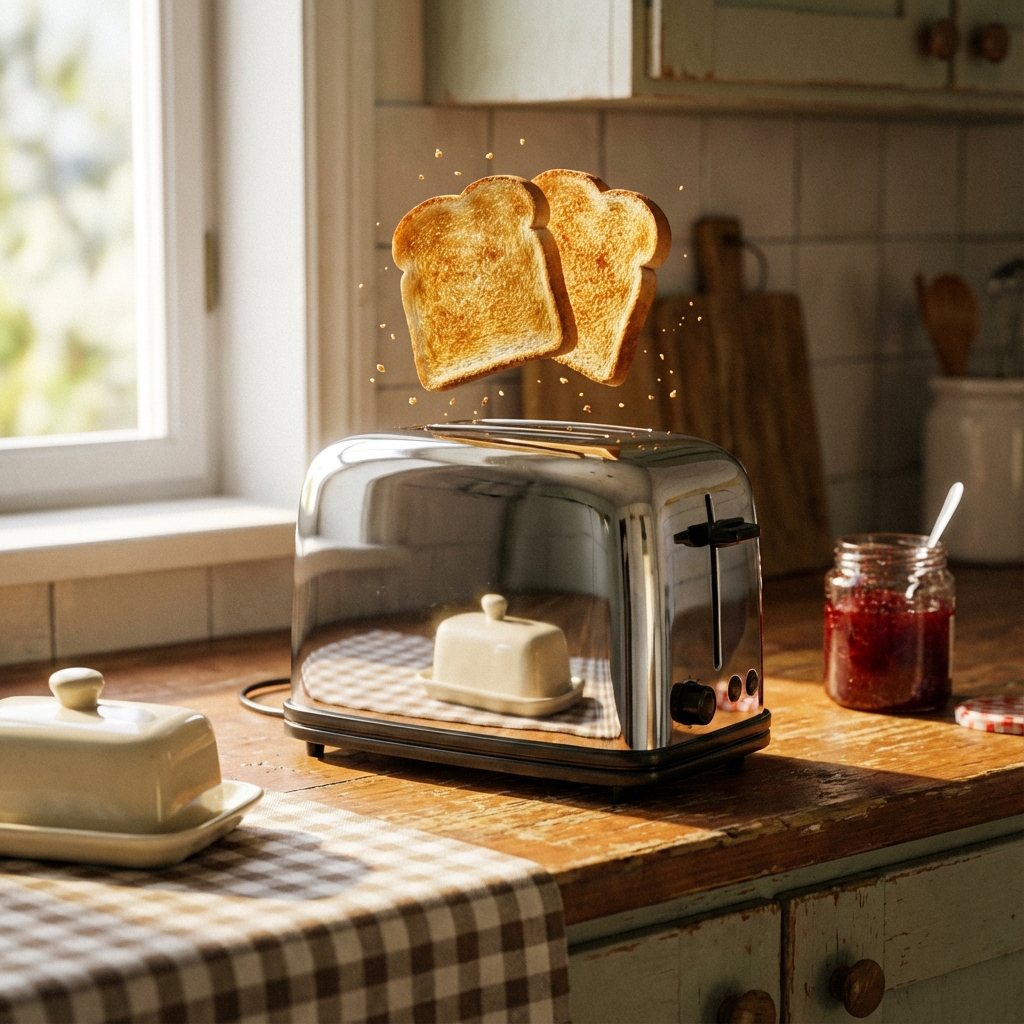
At first glance, the idea sounds ridiculous. A toaster is one of the simplest kitchen devices ever invented. You push a lever, bread goes down, toast pops up. End of story.
But then the word smart enters the picture.
Now we have toasters with touchscreens, smartphone apps, browning algorithms, and promises of “perfect toast every time.” Suddenly, a device that once relied on a spring and a heating coil is talking about sensors and presets.
So the question becomes unavoidable: if a toaster gets smart enough, does it cross the line into robot territory?
On Is It a Robot?, we don't care about marketing labels. We care about behavior.
A robot must complete the Sense–Think–Act cycle in the physical world.
Let's see how a smart toaster holds up.
The Case For: How a Smart Toaster Looks Robot-Like
Sense
Many modern toasters already use sensors, even if we don't notice them.
- Temperature sensors to prevent burning
- Timers calibrated to heating elements
- In advanced models, optical sensors that monitor browning
At this level, the toaster is clearly sensing its internal environment.
Think
This is where “smart” features start to matter.
Some toasters:
- Adjust toast time based on thickness
- Compensate for a cold start vs a warm toaster
- Use presets for different bread types
These decisions are simple, but they are still decisions.
Act
The toaster absolutely acts in the physical world.
- Lowering bread into the slot
- Applying heat
- Stopping and ejecting the toast
Sense, think, act. All three boxes appear to be checked.
The Case Against: Why It Still Feels Wrong to Call It a Robot
No Environmental Awareness
A smart toaster does not understand the world around it.
- It does not know who is using it
- It cannot recognize bread vs a bagel without explicit input
- It cannot respond to unexpected situations
Its “sensing” is narrowly focused on internal conditions, not the broader environment.
No Autonomy
A key feature we associate with robots is autonomy.
A toaster never decides to toast on its own. It does not:
- Initiate actions without a human
- Choose goals
- Adapt its purpose
Without human input, it sits quietly on the counter.
No Meaningful Manipulation
Robots typically manipulate the world in varied ways.
A toaster performs exactly one task, in exactly one way, every time. Even when it adjusts timing, the outcome is the same: toasted bread.
The Gray Area: When Appliances Start to Blur
Here's where things get interesting.
Imagine a future toaster that:
- Uses a camera to identify bread type
- Tracks your preferences over time
- Coordinates with other kitchen devices
- Schedules itself based on your routine
At some point, the toaster begins to resemble a very narrow, very specialized robot.
But even then, its scope is tiny. It does not navigate space. It does not handle uncertainty. It does not interact meaningfully beyond its slot.
The Verdict
So would a smart toaster ever count as a robot?
- Traditional toaster: Tool
- Smart toaster: Smart appliance
- Highly autonomous future toaster: Borderline, but still not quite a robot
A smart toaster completes a limited Sense–Think–Act loop, but it lacks autonomy, adaptability, and environmental interaction.
Conclusion
Calling a toaster a robot stretches the definition too far.
Smart appliances are getting better at optimizing tasks, but optimization alone does not make something a robot. A robot is not just reactive. It is situational.
For now, your toaster remains what it has always been: a very good example of how machines can be clever without being robotic.