Is a Smart Thermostat a Robot? The Quietest Robot in Your Home
Smart thermostats sense, decide, and act inside your home. Does that make them robots? We analyze Nest and similar devices using the Sense–Think–Act framework.
Robot Conundrum
10/26/2025
It Never Moves, Yet It Makes Decisions for You
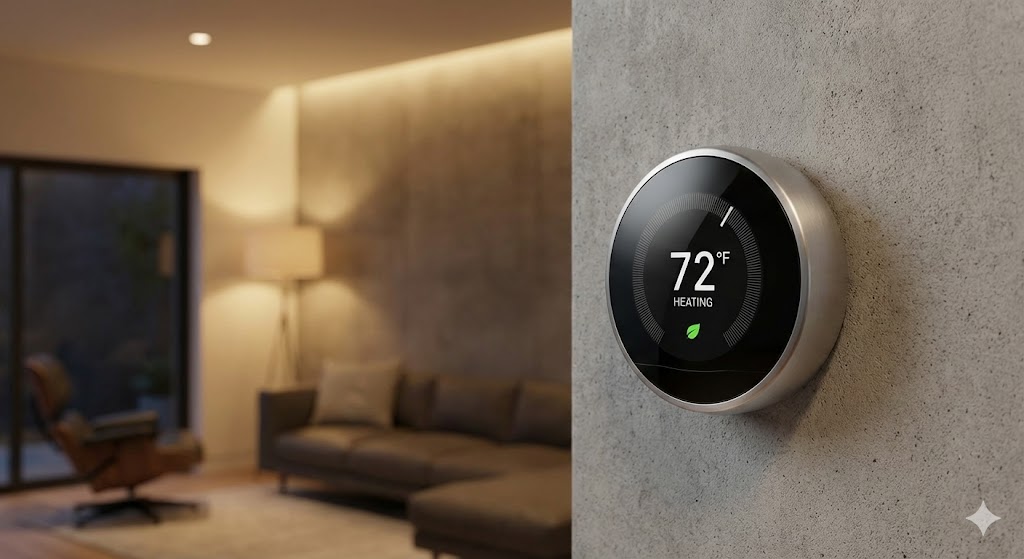
A smart thermostat doesn't roll across your floor or wave mechanical arms. It doesn't look robotic at all. Most of the time, it just hangs on your wall, glowing softly, pretending to be a slightly fancier version of the thermostat you grew up with.
And yet, this unassuming device watches your habits, predicts your schedule, and decides when to heat or cool your home—sometimes before you even realize you want it.
That raises a surprisingly serious question: if a device senses its environment, makes decisions, and takes physical action without asking you, is it a robot? Or is a smart thermostat just a clever appliance wearing a software upgrade?
What Counts as a Robot Around Here?
At Is It a Robot?, we don't rely on sci-fi imagery or marketing buzzwords. We use a practical engineering framework: the Sense–Think–Act cycle. A device that closes this loop on its own begins to move out of “dumb machine” territory and into something more interesting.
The Case For Calling a Smart Thermostat a Robot
Sense: Thermostats Are Always Watching
Modern smart thermostats are packed with sensors.
- Temperature sensors track indoor conditions
- Humidity sensors detect moisture in the air
- Motion or proximity sensors detect human presence
- Internet data pulls in weather forecasts
This means a smart thermostat doesn't just react to temperature changes. It builds a picture of what's happening in your home and outside it.
Think: This Is Where It Starts to Feel Robotic
Unlike old thermostats that simply compared the current temperature to a fixed setting, smart thermostats analyze patterns.
They may decide:
- When you usually leave for work
- When you come home
- How long your house takes to heat or cool
- Whether to preemptively adjust temperature based on weather
Some models adapt automatically, changing schedules without explicit programming. This is real decision-making, even if it's limited and narrowly focused.
Act: Quiet, But Very Real Control
A smart thermostat absolutely acts on the world.
It turns heating and cooling systems on and off, adjusts fan behavior, and controls energy usage throughout the day. These actions directly affect physical systems and your comfort.
Importantly, these actions are often taken without user input in the moment. Once configured, the thermostat runs autonomously.
The Case Against Calling a Smart Thermostat a Robot
Its World Is Extremely Small
A smart thermostat's universe consists of temperature, humidity, and occupancy. It does not understand why you are cold, what you are doing, or whether the house is hosting guests.
It operates within a tightly constrained problem.
No Physical Mobility or Manipulation
Many people instinctively associate robots with movement. Smart thermostats don't navigate space or manipulate objects. Their only physical influence is indirect, mediated through HVAC systems.
That makes them feel more like controllers than agents.
Learning Is Limited and Guardrailed
While smart thermostats “learn,” they do so within strict boundaries. They cannot invent new goals, explore alternatives, or redefine success. Comfort and efficiency are predefined by human designers.
The Gray Area: Controller, Agent, or Proto-Robot?
Smart thermostats live in an interesting gray zone. They are more autonomous than traditional appliances, but far less flexible than robots that operate in open environments.
They resemble what engineers call a closed-loop control system, enhanced by software and data. What makes them feel new is not raw intelligence, but independence.
Once installed, a smart thermostat doesn't wait for commands. It anticipates.
Verdict: Robot, Machine, or Smart Appliance?
So, is a smart thermostat a robot?
Verdict: Smart Appliance (With Robotic Traits)
A smart thermostat clearly completes the Sense–Think–Act loop. It senses conditions, makes decisions, and acts autonomously. However, its scope is narrow, its environment is limited, and its behavior is tightly constrained.
Calling it a robot isn't wrong from a technical standpoint, but it stretches the everyday meaning of the word.
What Smart Thermostats Reveal About the Future
Smart thermostats show us that robots don't always arrive with fanfare. Sometimes they show up quietly, mounted on drywall, making decisions while you sleep.
As more household systems gain sensors, connectivity, and autonomy, the line between appliance and robot will continue to blur.
The smart thermostat may not feel like a robot, but it represents something important: the moment machines stopped waiting for instructions and started acting on our behalf.