Types of Robots: Industrial, Service, Social, and Autonomous
Not all robots are built the same. We break down the major types of robots—industrial, service, social, and autonomous—using real-world examples and the Sense–Think–Act framework.
Robot Conundrum
12/27/2025
“Robot” Is Not a Single Category
Ask ten people what a robot is, and you'll get ten different answers. Some picture factory arms welding cars. Others imagine humanoid assistants, delivery bots, or talking machines with expressive faces.
Part of the confusion comes from treating “robot” as a single thing. In reality, robot is an umbrella term covering machines with very different purposes, designs, and levels of autonomy.
To make sense of modern robotics, it helps to stop asking “Is it a robot?” for a moment and instead ask: what kind of robot is it?
Let's break down the major categories you'll encounter today—and what actually separates them.
A Quick Reminder: What Makes Something a Robot?
At Is It a Robot?, every robot—regardless of category—must satisfy the same Sense–Think–Act loop:
- Sense: It gathers data from the world
- Think: It processes that data and makes decisions
- Act: It physically affects the world based on those decisions
What changes from type to type is how much sensing, thinking, and acting happens, and how independently the robot operates.
Industrial Robots
What They Are
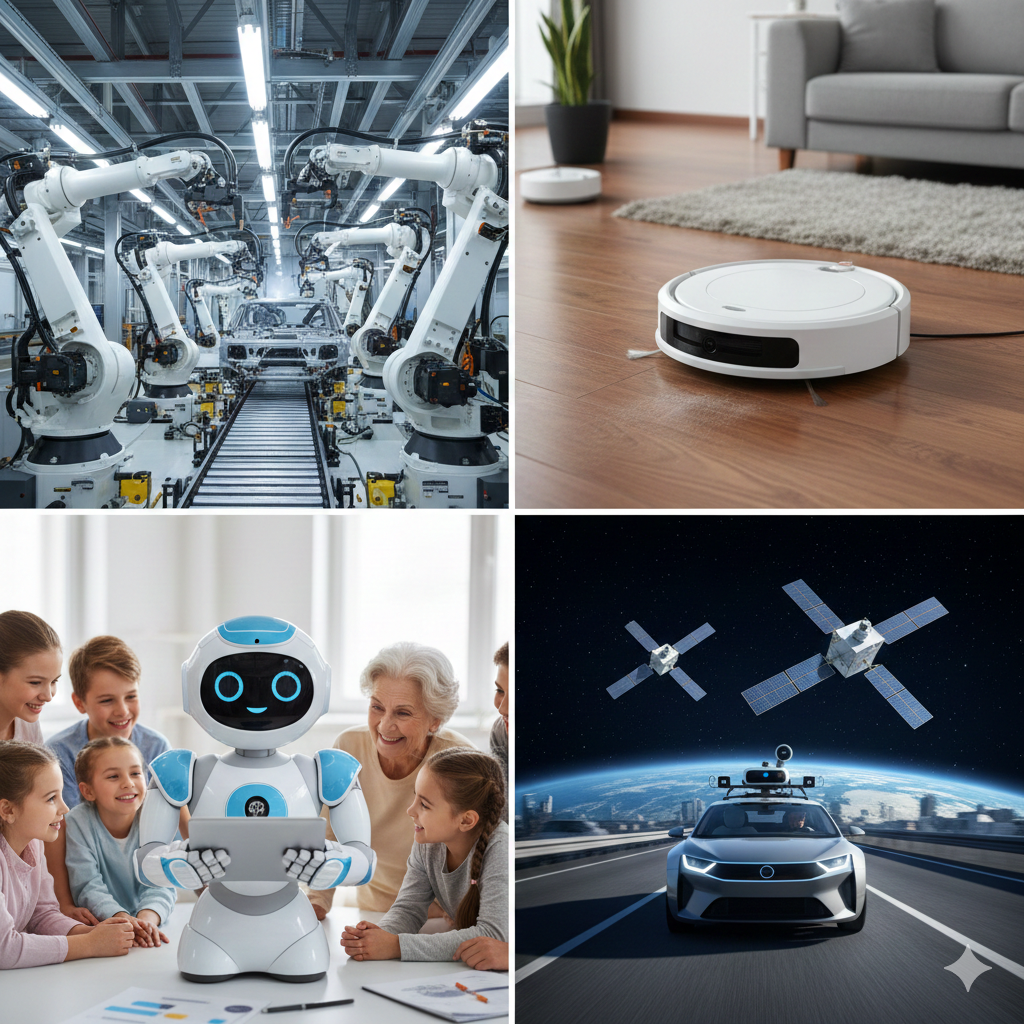
Industrial robots are the backbone of modern manufacturing. They are usually fixed in place and optimized for precision, speed, and repeatability.
Common examples include:
- Robotic arms on assembly lines
- Welding robots
- Painting and coating robots
- Pick-and-place systems
How They Sense, Think, and Act
- Sense: Joint encoders, force sensors, vision systems
- Think: Preprogrammed logic, motion planning, safety checks
- Act: Precise, high-force physical manipulation
Industrial robots are often low on “intelligence” but extremely high on reliability. Many perform the same task millions of times with minimal variation.
What Makes Them Distinct
They operate in controlled environments and usually do not interact directly with the public. Their intelligence is narrow, but their impact is enormous.
Service Robots
What They Are
Service robots assist humans outside of traditional factories. Their environments are less predictable, and their tasks are more varied.
Examples include:
- Robot vacuums and mops
- Delivery robots
- Hospital transport robots
- Agricultural robots
How They Sense, Think, and Act
- Sense: Cameras, lidar, bump sensors, GPS
- Think: Navigation, obstacle avoidance, task scheduling
- Act: Movement, cleaning, carrying, dispensing
Service robots are more adaptable than industrial robots, but usually less precise and less powerful.
What Makes Them Distinct
They operate in human spaces and must handle unpredictability. That makes them feel more “robotic” to most people, even when their intelligence is limited.
Social Robots
What They Are
Social robots are designed primarily to interact with people, not objects.
Examples include:
- Companion robots
- Educational robots
- Customer service robots
- Therapeutic robots
How They Sense, Think, and Act
- Sense: Cameras, microphones, touch sensors
- Think: Speech processing, gesture recognition, scripted dialogue
- Act: Speaking, gesturing, facial expressions
Social robots often appear intelligent because humans are very sensitive to social cues. Even simple scripts can feel lifelike.
What Makes Them Distinct
Their value lies in perception, communication, and emotional response—not physical labor. In terms of raw autonomy, many social robots are less capable than quieter machines doing real work.
Autonomous Robots
What They Are
Autonomous robots are defined less by their job and more by their independence.
Examples include:
- Self-driving cars
- Drones
- Autonomous underwater vehicles
- Space probes and satellites
How They Sense, Think, and Act
- Sense: Cameras, radar, lidar, inertial sensors
- Think: Planning, prediction, fault handling
- Act: Navigation, steering, thrust, manipulation
Autonomous robots must make decisions without constant human oversight, often in dangerous or remote environments.
What Makes Them Distinct
They are judged by how well they handle uncertainty. Autonomy is not about being smart—it's about being reliable when no one is watching.
The Overlap: These Categories Are Not Boxes
Many robots belong to more than one category.
- A warehouse robot is both industrial and autonomous
- A delivery robot is both service and autonomous
- A humanoid assistant may be social and service-oriented
These labels are tools, not laws. They help us talk about robots, not define their limits.
Why Understanding Robot Types Matters
When we argue about robots, we often talk past each other. One person is thinking about factory arms. Another is imagining humanoid companions.
The Bigger Picture
Robots are not converging toward a single form. They are diversifying.
As sensing, computation, and actuation become cheaper, robots will continue to appear wherever a feedback loop can replace human attention.
Some will look dramatic. Most will look boring. All of them will make more sense once we stop treating “robot” as one thing and start seeing it as a family of machines.